


Hello! Welcome to Classics Read Aloud. I’m Ruby Love, and I’m delighted to bring you a curated stream of excellent literature—mostly short stories, and the occasional novel.
The public domain archives are awash in terrific things to read, and I am having immense fun hunting around for the most entertaining of morsels. Please sign up to receive new readings directly to your inbox!
“Then, placing my foot on a piece of paper, he would two or three times tickle the outer edges with a pencil and pass his nervous fingers over my toes, feeling himself into the heart of my requirements.”
One hesitates to draw too many conclusions about the personality of an author based solely on his or her written work. That said, I was hardly surprised in my research to find John Galsworthy described as a quiet intellectual, somewhat aloof and reserved. It seemed to me only natural that someone inclined to introspection would write a story like “Quality,” which patiently burrows into the modest but artful industriousness of a cobbler’s shop, like a mouse burrowing into the toe of a shoe.
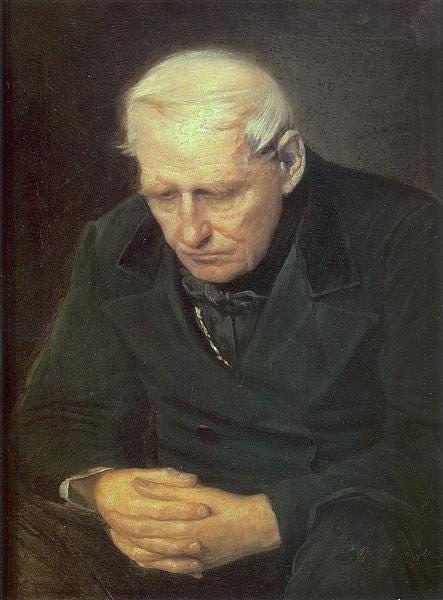
John Galsworthy began writing in the 1890s after meeting Joseph Conrad, with whom he developed a long and mutually supportive friendship. Having been in the midst of a budding legal career, this allowed him to continue working pen-to-paper and simply alter the objective of the output. He nonetheless initially wrote under a pseudonym—John Sinjohn—to avoid disappointing his family with the shift. By 1904, Galsworthy was writing under his own name and in 1906 published The Man of Property, the first book of what became the renowned The Forsyte Saga series, later popularized with a BBC episodic in 1967 (and more recently with the excellent remake starring Damien Lewis in 2002).
Much of Galsworthy’s work interrogates the struggle between the individual and society during a period of rapid industrial upheaval. In “Quality,” originally presented as a play and subsequently published as a short story, we are witness to this change on the business of a high-end bootmaker through the eyes of a lifelong customer. The plight of the hard-working Gessler brothers asks the reader to acknowledge the hypocrisy and trade-offs inherent in “progress.” Galsworthy doesn’t bemoan the progress, per se, simply the associated casualty of quality and the respect its craftspeople once commanded.
Please enjoy…

Stomping: My most beloved pair of shoes has never touched outdoor ground. I clomp around the house in a pair of Dansko clogs; the same pair, for at least four years (and the same brand for at least 20). I’ll probably replace them after five, just because. I slip them on the second I get home, and there they stay until the pajamas go on. They are hardly fashionable, but they are perfect: I’m high in solid form, and everyone in the house can hear me coming, like Darth Vader. Pray Dansko never goes out of business.
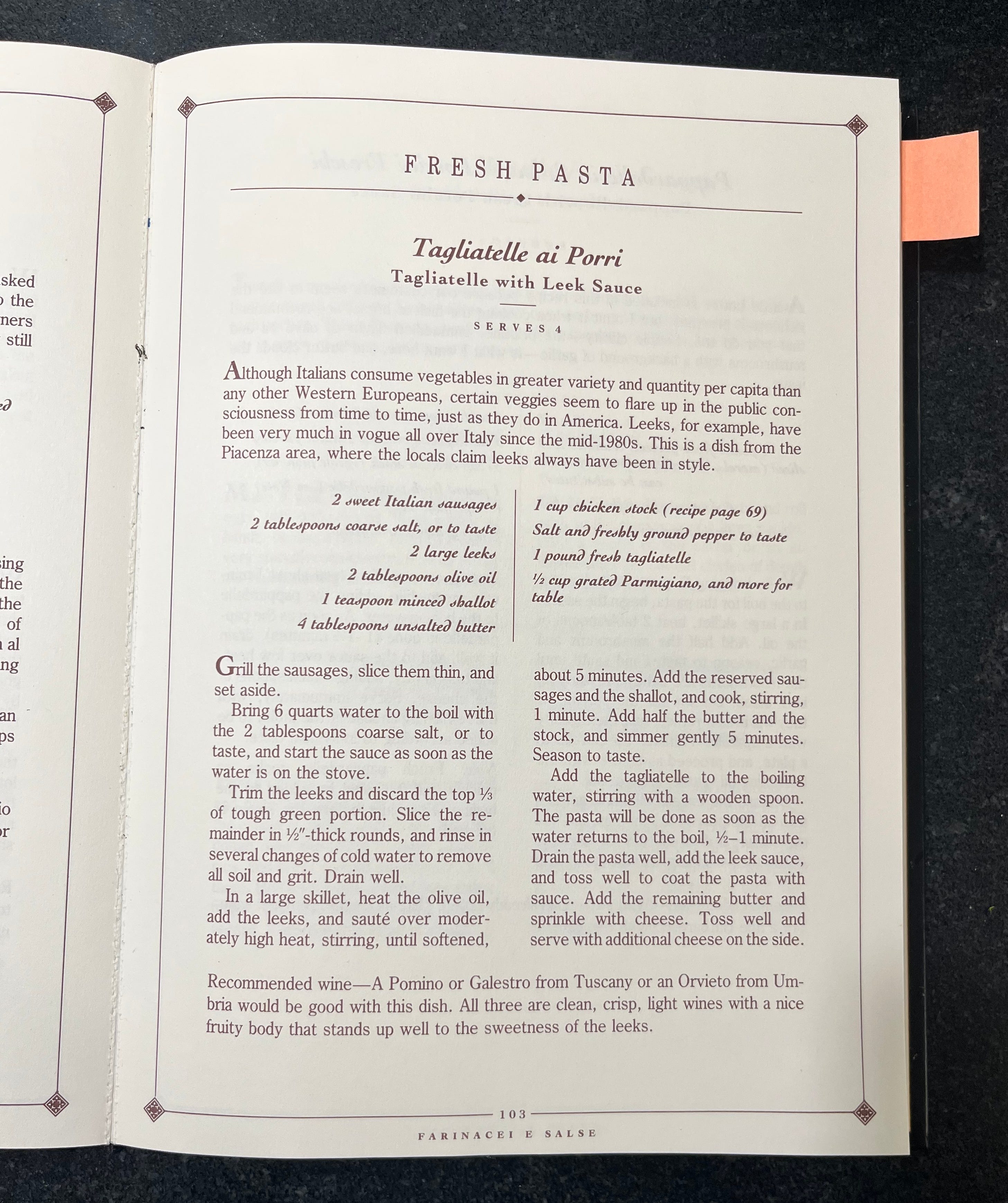
Savoring: I love cooking, probably even more than I love reading, and I enjoy sharing recipes here. It seems you like it too, as these are the most frequently clicked resources in the “et cetera” section. I can’t claim any rights to the stellar dish I made for dinner last night…I simply pulled my copy of Lidia Bastianich’s La Cucina de Lidia off the shelf and opened it to the well-worn page for Tagliatelle ai Porri (Tagliatelle with Leek Sauce). I don’t actually need the recipe anymore—I’ve made this so many times, and it is beyond simple—but I just enjoy the look and feel of this book. It’s a pleasure to have it out on the counter and to envision her cooking these dishes in her own kitchen.
I generally have a “buy good leeks if you see them” policy, and I recommend you should, too. They’ll never go to waste so long as you enjoy savory, cozy soups, pastas, and gratins. This recipe is a fail-proof use of them.
If you have the time and interest for homemade pasta, lovely, but if not, Granoro dried pasta is phenomenal.

“The Gift of the Magi” by O. Henry, 1905
A Christmas Carol by Charles Dickens, 1843
“Christmas on the Roof of the World” by Ernest Hemingway, 1923


