

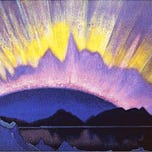

Hello! Welcome to Classics Read Aloud. I’m Ruby Love, and I’m delighted to bring you a curated stream of excellent literature—mostly short stories, and the occasional novel.
The public domain archives are awash in terrific things to read, and I am having immense fun hunting around for the most entertaining of morsels. Please sign up to receive new readings directly to your inbox!
With today’s reading, I’d like to focus your attention on Andersen’s dazzling imagery. This adventurous tale is a treat for our senses and creative instincts.
Andersen, naturally, opens by setting the stage with an enchanted challenge that must be overcome. One day, devilish sprites create a mirror whose every reflection is a twisted and frightful distortion. They revel in their mischievous creation, flying up into the air with delight. “The higher they flew with the mirror, the more terribly it grinned.”
The sprites’ antics end with a crash as the mirror slips from their control and is dashed into “a hundred million and more pieces” that wreak havoc far and wide.
Two splinters of mirror find their way into the heart and eye of a little boy named Kay. He and his dear friend, Gerda, live beside each other—“They were not brother and sister; but they cared for each other as if they were”—and meet often on the roof between the two garrets where “the tendrils of the peas hung down over the boxes; and the rose-trees shot up long branches, twined round the windows, and then bent toward each other; it was almost like a triumphant arch of foliage and flowers.”
With two sharp pains, the lodged shards afflict Kay. He rejects all that is good and pure, including Gerda, and is soon taken captive by the powerful Snow Queen, whose kiss “was colder than ice; it penetrated to his very heart.” In his mirror-twisted vision, it is she who becomes beautiful and clever to him.
“On they flew over woods and lakes, over seas, and many lands; and beneath them the chilling storm rushed fast, the wolves howled, the snow crackled; above them flew large screaming crows, but higher up appeared the moon, quite large and bright; and it was on it that Kay gazed during the long long winter’s night; while by day he slept at the feet of the Snow Queen.”
Little Gerda, full of innocence and determined dedication to her friend, strikes out to find him amidst the vast unknown, leaving behind everything she knows. All manner of fauna and flora awakens to her goodness—“…when her warm tears watered the ground, the tree shot up suddenly as fresh and blooming as when it had been swallowed up”—and royal chambers open to her solicitation—“The ceiling of the room resembled a large palm-tree with leaves of glass, of costly glass; and in the middle, from a thick golden stem, hung two beds, each of which resembled a lily. One was white, and in this lay the Princess; the other was red, and it was here that Gerda was to look for little Kay.”

The fearless Gerda makes her way, mile by mile, from the cherished gardens of her hometown through the frozen great North to rescue Kay, buoyed always by her earnestness and purpose—“’I can give her no more power than what she has already. Don’t you see how great it is? Don’t you see how men and animals are forced to serve her; how well she gets through the world barefooted?’”
This is just a small taste of the banquet laid on Andersen’s narrative table. Surely, Andersen’s story has influenced many a modern cinematic tale, but none capture the glory of that which exists in our mind’s eye, as guided by his words. His expressive scenes breathe life into the many dichotomies suggested in this tale, which pits good against evil and logic against faith.
As you listen, what images strike you the most?
“♡ Like” this piece or be captured by the Snow Queen.

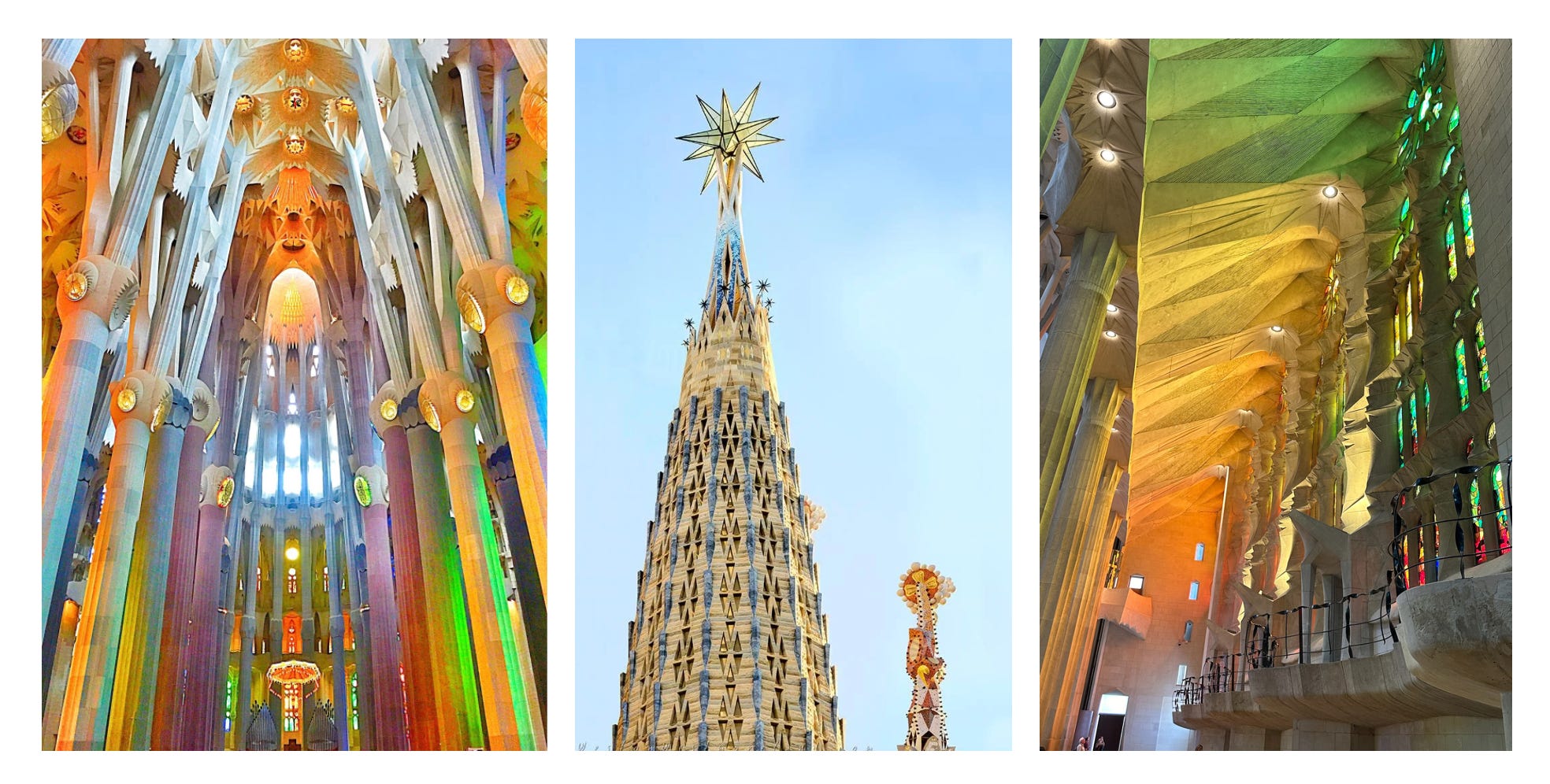
Glowing: Written in 1844, many scenes of “The Snow Queen” call to mind the similarly fantastical imagination of Antoni Gaudi, an architect of the same era. His unfinished masterpiece, La Sagrada Família (“Church of the Holy Family”) in Barcelona, bursts with a crystalline kaleidoscope of color and dazzling ornamentation that seems very much in harmony with Andersen’s vision.

“To Build a Fire” by Jack London, 1908
“Leave It to Jeeves” by P.G. Wodehouse, 1916
Peter Pan, an excerpt, by J. M. Barrie, 1911


