


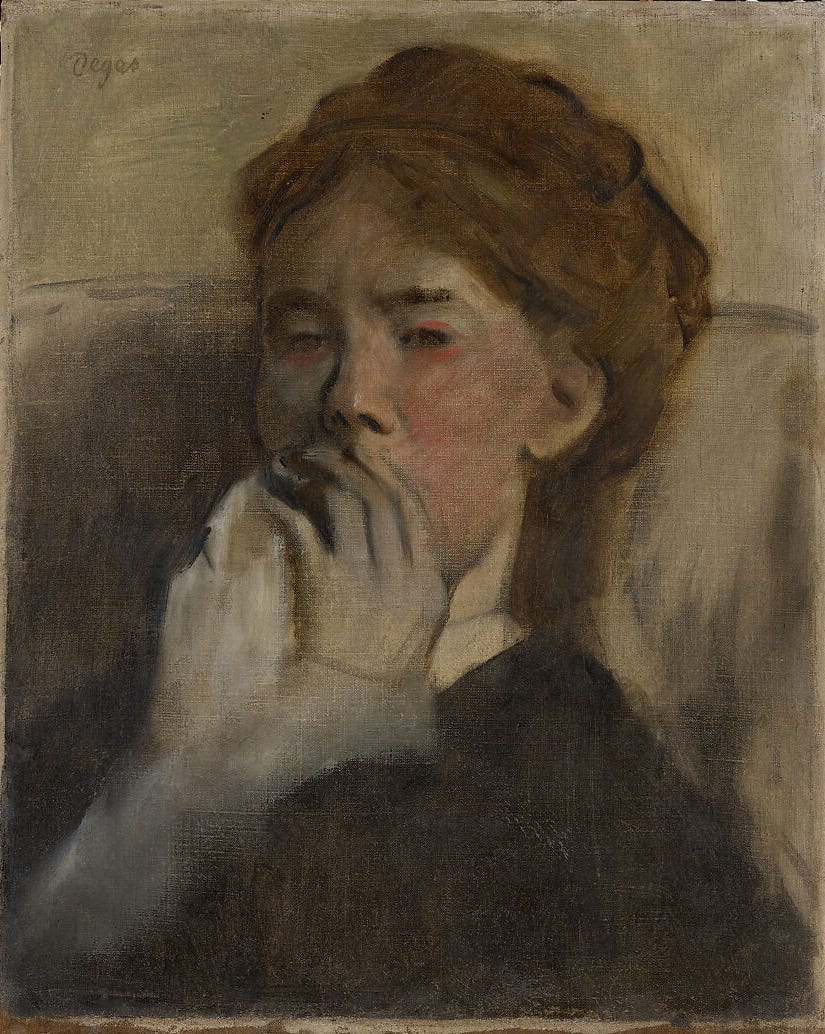
“Through the wide doors of the sheds she caught a glimpse of the black mass of the boat, lying in beside the quay wall, with illumined portholes. She answered nothing. She felt her cheek pale and cold and, out of a maze of distress, she prayed to God to direct her, to show her what was her duty.”
In the early 1900s, James Joyce set out to capture Irish life as he saw it, which wasn’t a particularly encouraging view. The resulting collection of short stories was published under the title Dubliners in 1914, overcoming years of delay from protests over the indecency of its controversial tone. Comprising fifteen stories grouped into four stages—childhood (listen to a reading of “Araby” from this grouping), adolescence, maturity, and finally public life—Dubliners delivers powerful glimpses into the crossroads of life.
Joyce began writing these stories as he was attending medical school in Dublin, and his studies greatly affected the tone and purpose of Dubliners. At the time, he spoke often of the tepid life-force of his countrymen in specifically medical terms. As scholar Florence L. Walzl observed, Joyce “concluded that Ireland was sick, and diagnosed its psychological malady as hemiplegia, a partial, unilateral paralysis. He told his brother, ‘What’s the matter with you is that you’re afraid to live. You and people like you. This city is suffering from hemiplegia of the will.’”
Today’s story, “Eveline,” is from the adolescence phase of the collection, but originally appeared in an edition of Irish Homestead in 1904. In it, a young woman is on the precipice of a life-altering move away from her dour life of servitude under an abusive father and towards open possibility in another country with a man who loves her. One gets the sense that, while Joyce conjures up the reader’s deep sympathy with Eveline’s ultimate impotence, he doesn’t care to join us in it but would rather rebel against the suspension of will that inspired it—a masterful achievement in so few words.
Please enjoy…
Don’t get stuck in a paralysis hovering over that “♡ Like” button… each tick makes a meaningful impact in signaling to others that this is a publication worth the time. I am grateful for your support!

Savoring: This week I finally mastered a dinner I have been fine tuning for longer than I care to admit. A cozy, humble pasta dish of tomatoes, white beans, and petite ditalini noodles, inspired by Stanley Tucci’s description of his Italian grandmother’s cherished brothy tomato and ditalini soup, as well as my memory of old-school Spaghetti-O’s enjoyed as a child, became a compelling vision that simply would not release me. It took more than half a dozen attempts, but I’ve got it now and can’t wait to make it again.
If only I could comfort Eveline with a hearty bowl, hot off the stove. It would bolster even the most forlorn of souls to believe that things might just be better in the morning.


“Babylon Revisited” by F. Scott Fitzgerald, 1931
“The Egg” by Sherwood Anderson, 1921
“Bartleby the Scrivener” by Herman Melville, 1853


