


Hello! Welcome to Classics Read Aloud. I’m Ruby Love, and I’m delighted to bring you a curated stream of excellent literature—mostly short stories, and the occasional novel.
Please sign up to receive new readings directly to your inbox!
“Sometimes it was dark and sometimes light, and now they were very cold and again too warm. Did they really feel hungry at times, or were they merely pretending...?”
I was inspired to pick up Peter Pan after reading “What I Learned from Reading Peter Pan to my Children” last year, a most excellent essay from Henry Oliver at The Common Reader. Oliver does a brilliant job reminding us that, beyond the familiar nostalgia associated with the story of “the boy that never grows up,” Peter Pan is a tale that cherishes the intricate temporality of childhood and the nourishing inevitability of motherhood: “What wins out in this story is not the pleasure of Neverland, but the certainty of a mother’s love. The true, original title is Peter and Wendy, and she is our real hero.”
What mother wouldn’t be called to reread such a tribute?
Truth be told, I’m not sure that this wasn’t my first full reading of J. M. Barrie’s masterful tale. It is quite possible that I only saw plays and, of course, the Disney animated version, in my youth. Even more unfortunate, I haven’t read it to my own children… ah, to go back in time!
As with my rereading last year of Alice’s Adventures in Wonderland, I enjoyed this dive back into “children’s” literature immensely. There is such a dearth of wholesome imagination in contemporary children’s entertainment that it is a great pleasure to examine some of the weightier topics (existence, duty, and our place in the world) with writers like Barrie and Carroll, who respectfully traverse that blurry space between the real and the imaginary.
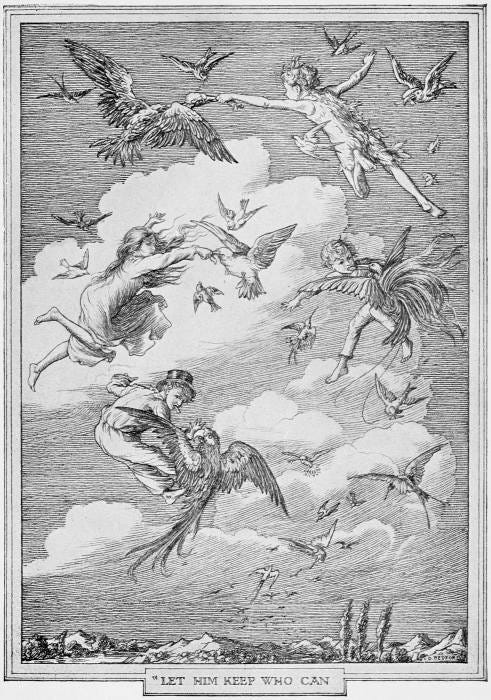
I have plucked an excerpt from early in the book—Chapter 4, The Flight—which picks up just as the Darling children have launched into the night air, destined for the beckoning Neverland (“…the island was looking for them. It is only thus that any one may sight those magic shores”). It is in this chapter that Wendy digests the limitations of Peter’s character and the risks it presents to her brood, initiating a motherly care, both charming in its naiveté and earnest in its delivery, that develops throughout the rest of the book.
I hope this chapter inspires you to revisit the original, cover to cover.
Please enjoy…
Before you take flight to enjoy the story, please help Classics Read Aloud grow by “♡ Liking” this post and sending it to a friend—word of mouth is more powerful than any algorithm. Thank you!

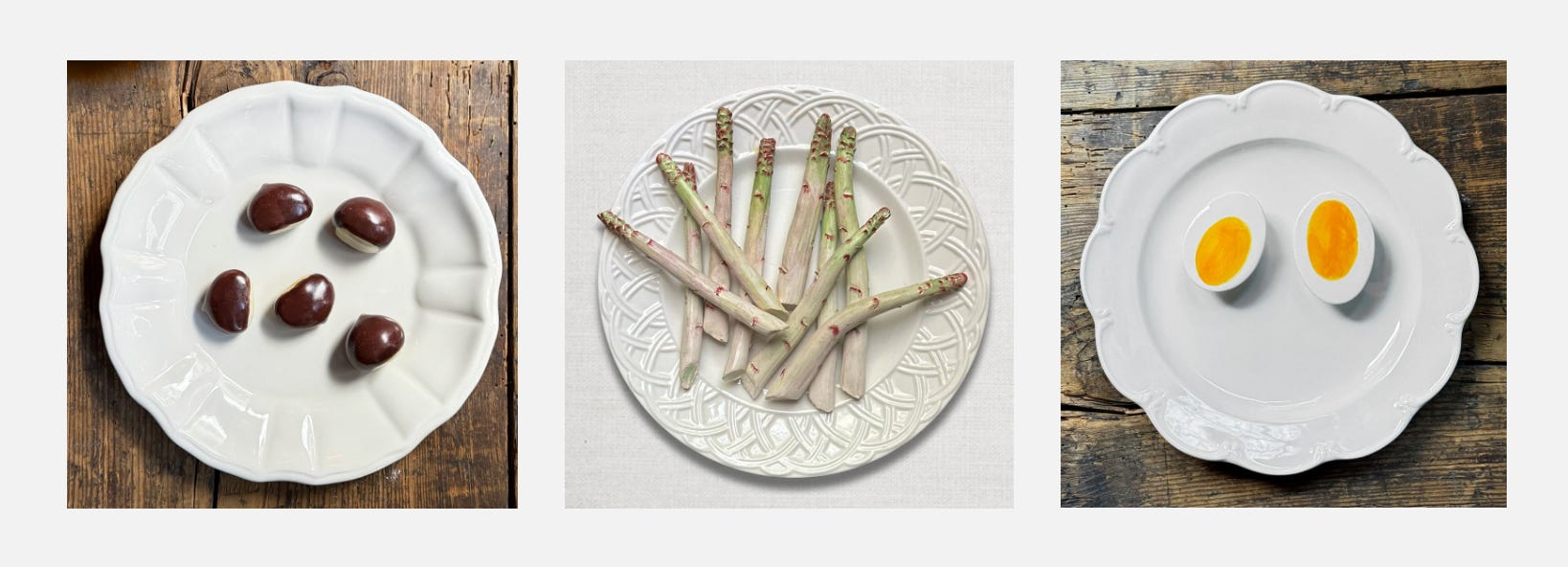
Pretending: When children do it, it’s called “make believe,” but when the adults are at the helm, the preoccupation gets dressed up with sophisticated terms (and very real price tags). Take these charming trompe l’oeil plates offered from tastemaker John Derian, which give grown-up delight to the pretend play of degustation found all throughout Barrie’s tale. I just love the eggs, the asparagus, and the hazelnuts.

“The Hounds of Fate” by Saki, 1911
“Paste” by Henry James, 1899
“The Necklace” by Guy de Maupassant, 1884


